The Muse Labs
Ritual Journal Entries and Video
2010-2019 by Antero Alli
n
"Pearls & Perils of Courting the Muses", (2020; 8:43)
features
an excerpt from the book "STATE OF EMERGENCE"
accompanied by clips from two of my films inspired by
the
Muses archetype, alongside footage from a few
group paratheatre sessions. - Antero
Between 2010 and
2019, I explored the Muses dialogue through a series of the group ritual labs (running between 8-12 weeks each, meeting once or twice a week for 3 hours). These somatic, visceral processes inspired the scripting and production
of four feature-length art films and the creation of five paratheatrical productions (see images below). I won't attempt to explain the Muses enigma here but rather, share some notes on how I have responded to the phenomena as it continues to impact my personal, artistic, and spiritual life. - Antero, December 1, 2020, Portland OR
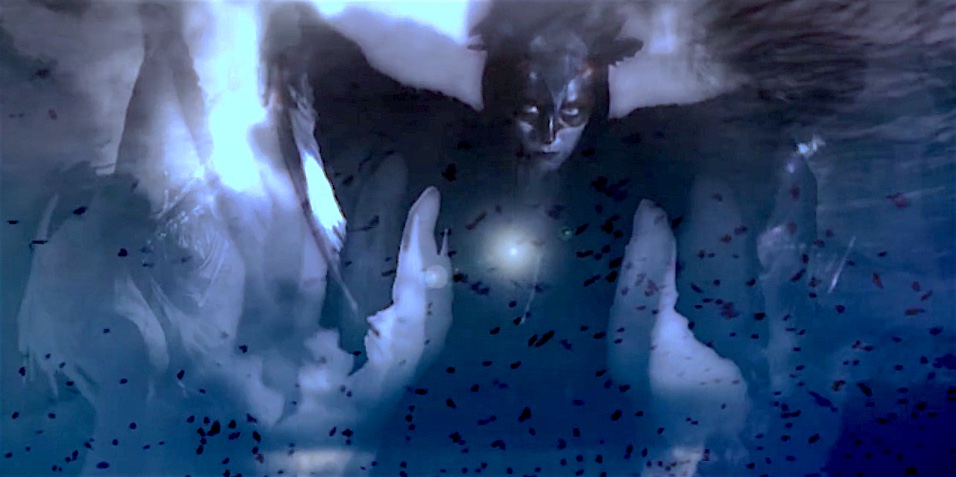
Raven Goddess in "The Book of Jane" (2013; 117 min.) Film - click for info
Muses Need Vessels
Though there seems to be certain attributes and conditions the Muses archetype finds more appealing than others, the nature of these qualities can differ for each person or, as I like to look at it, for each vessel the Muses choose for their purposes. People don’t choose Muses; Muses choose their own vessels. We don't own the Muses. They are not my Muses or your Muses but the Muses. The Muses work through us and then, discard their vessels when we cease to be useful or appealing to them. Muses run their own impersonal and autonomous agendas beyond the control and the comprehension of anyone courting their favor. Note to self: the Muses can be fussy, fickle entities; don't expect consistency. Stay receptive.
I see three basic types of Muse vessels: creatives (those who live creative lives but don’t necessarily produce art; almost all children are "creatives"), artists (those who produce art and/or call themselves "artists") and creative artists (those whose art develops from living creatively, whether they call themselves "artists" or not). All three vessels represent individuals who sometimes project archetypal Muse status onto others by mythologizing anyone who looks or behaves like a Muse to them. Though these psychic projections can initally arouse romantic, erotic, intoxicating and inspiring emotions, they can also lead to disastrous interpersonal relations. What mortal can live up to anyone's exalted Muse ideal? None I have met or known. Note to self: one does not marry the Muse. Don’t romance or mythologize or worship the Muses.
The Muse beckons me towards the Unattainable. When the Muse strikes and takes hold, I sometimes feel beside myself, possessed of a kind of madness. Not insanity exactly, more like a joyous, gleeful obsession. Like a moth sputtering around an open flame, my heart flutters, takes flight towards the Impossible in a fever dream, inflaming l'amour fou. The inner mounting flames of Muse-inspired passion or obsession can consume everything and everyone in its wake. I lament the broken hearts and ruined lives of all the men, women, and children charred by the creative firestorms of my own Muse-projections. I am guilty here. Note to self: Court the Muses, not as a lover but as an interaction with the Mysteries. Muses are not always kind, wonderful, and loving. They can be ruthless, severe, and unforgiving.
Courting the Muses can sometimes feel like falling madly deeply in love, a delirium ravaging the soul like a rag doll tilt-a-twirling in gale-force winds. And in this feral astral theatre, the Muses witness my little drama with high indifference. No matter how inspiring or stimulating, their influence creates its own unique stresses on the instrument of self. If I fall sick or suffer pain or collapse and die, the Muses don't care; they simply move on to their next available vessel. The Muses don't care about what happens to me; they only care about how well their Presence finds expression through their vessels. If I do not care for the health and maintenance of my instrument of self, the vessel, I become useless to the Muses. Note to self: -- treat the Muses with the same indifference they treat me. To stay related with the Muses, it's my responsibility to maintain the instrument of self; stay healthy.
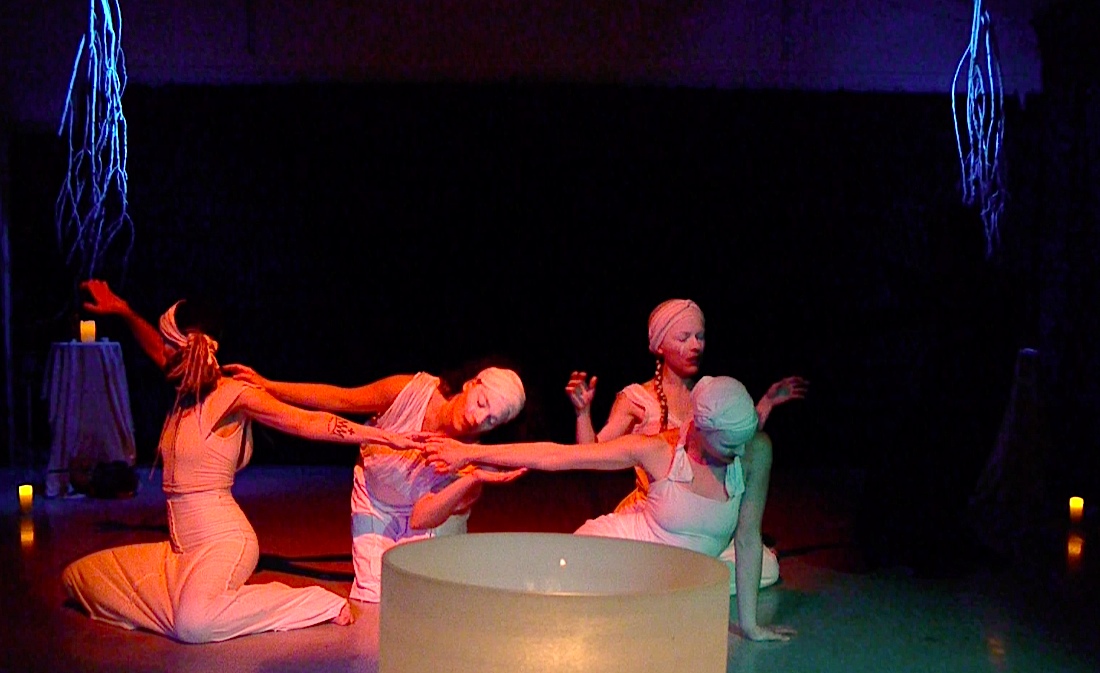
"Soror Mystica" (Dec. 2017 ParaTheatrical performance) click image
Appealing to the Muses
Confession - I have become a happy love slave to the Muses. Over forty years of creating original works for experimental theatre, music, and cinema I have discovered certain conditions I need to maintain in my daily life for the Muses to find me appealing. How to appeal to the Muses? What routines, thought adjustments, and outlooks keep me receptive to the Muses’ signals, timings, whispers ? For example, I have found that minimizing the word "is" in my thinking, speaking and writing has helped collapse formulaic, over-literalist thinking that can shrivel the imagination, the conduit for Muse reception. Note to self: I am not the "creator" but a translator of the Muse's signals. The real payoff for making Art is neither fame or money or love or power; the payoff is realizing my purpose.
The Muses’ demand exposure and elimination of “creative buffers” -- those habits, beliefs, events, and people that impede or diminish critical receptivity. Meeting these demands to stay receptive has made me more socially selective about the company I keep. Some people, no matter how good their intentions, distract my process and drain my energy. Muse dialogue is not about talking to myself or confusing the inner critic or conscious mind or ego with the Muse. Imposter voices! Muse interactions are rarely verbal. They're more like ineffable impressions or silent signals like flames passing between the transpersonal realms and my purposefully uneventful, low-drama daily life.
Note to self: soap opera antics and senseless bickering creates static that obscures the Muses signals. Best to keep the human drama onscreen or on the theatrical stage or in the music.
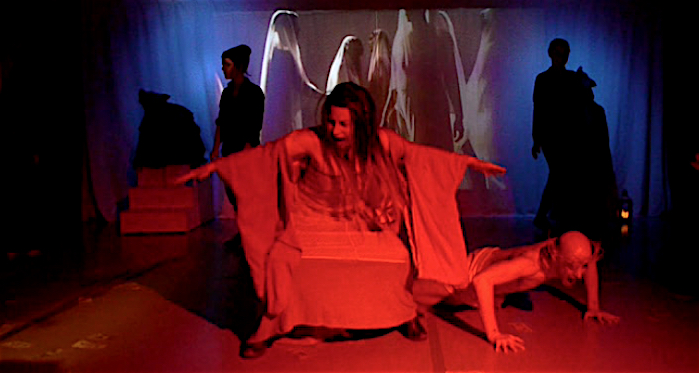
"Escape from Chapel Perilous" (Dec. 2018; ParaTheatrical performance)
Tested by the Muses
The Muses demand respect. I never call them “my Muses”; if they can be be owned, they are not Muses but ego trips. I call them the Muses for good reason. They come and go on their own accord and their own schedule or timing. They are not on my watch;
I am on their watch. When the Muses disappear, I take it as a sign to earn more patience by tending to the fallow fields between projects, the art of doing nothing -- sometimes, for months or dry spells lasting years at a stretch. This back and forth, between action and inaction, expresses a dynamic balance between the stimulation-oriented sympathetic nervous system and the rest-oriented parasympathetic nervous system. Too much of one or the other can throw the whole system off. Note to self: my value to the Muses does not depend on constant productivity but periods of rest and recovery where receptivity can be restored. Only when I am empty can the Muses take notice and make use of me.
Whenever I become too full of myself -- gloating over past successes, achievements, accolades -- the Muses are bored to tears and start eyeing other vessels. I remember times when I was obsessed with some brilliant idea that would unexpectedly appear in somebody else’s project. W.T.F. ?! Did I wait too long? Why did I not follow through when the idea came to me? Note to self: without commitment and follow-through, the best ideas languish in the maze of the mind, lighting and leaving for other vessels. Commitment acts as a force. To stay attractive to the Muses, learn to increase the force and heat of my commitment. Thou shalt not bore the Muses!
The Muses test my faith whenever I worry about where all the resources will come from to produce my next film or theatre project: the talent, the technology, the passion, the time, the money?! The Muses mock all my petty concerns. The Muses know that money is not the same as wealth. The Muses trade in the currency of talent, technology, time, love, and yes, money -- all express subcategories of the larger category of true Wealth. Worrying about what I don't have disrespects existence and gratitude for the existing conditions of my actual life. Gratitude, the chief inlet of True Wealth. Note to self: Gratitude, not attitude. Without gratitude, I am fucked.
EXCERPTED FROM
"STATE OF EMERGENCE: Experiments in Group Ritual Dynamics"
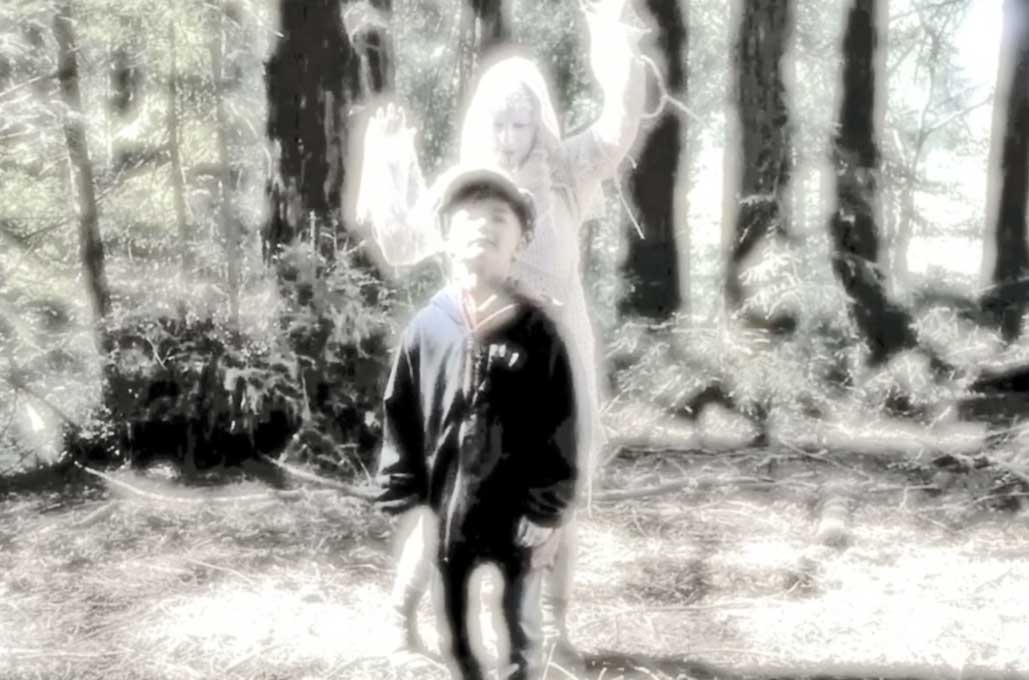
"OUT OF THE WOODS" (2015/2021; 87 min) Film - click for info
2010 - 'MUSES LAB' REPORT #1
RITUAL JOURNAL ENTRIES
2011 - 'MUSES LAB' REPORT #2
RITUAL JOURNAL ENTRIES
2016 - "A TURBULENCE OF MUSES"
Vision statement for Performance Ritual
2019 - THE FINAL MUSES LAB - PORTLAND
Lab Intent and the Application of the 5 Intentions
VIDEO DOCUMENTS OF PARATHEATRICAL PRODUCTIONS
Non-performance and performative modes from 1991-2020
~ TO BE CONTINUED ~
ParaTheatrical ReSearch Site Map