Part Three: The Performer/Audience Romance
the need for love, talent & skill, the total act, No-Form
© 2005 Antero Alli (updated 2/3/21)
FALLING IN LOVE WITH WHAT
The torrid romance of audience/performer dynamics is fraught with mystery, anticipation, and insecurity. The tremulous rush of stage fright does not come from any promise of long-term relationship but the spine-tingling prospect of an eternal one-night stand. Theatrical conventions of distance (the fourth wall), talent, and skill naturally separate performers and audience, a separation sealed by post-performance audience applause. The audience/performer power dynamic tips and sways with fickle electricity; one night we're up and on, the next night we're down and out. As with any one-night stand, the audience/performer romance remains unpredictable and most performers would not have it any other way.
Can real connection between performer and an audience actually occur ? Yes and no. Real connection between audience and performer may not be possible through any direct attack -- presentational confrontations where the performer directly manipulates and/or emotionally assaults the audience. Whether it's via seduction, performer charisma or the performers' "need to please and be liked or to impress others" -- or the more aggressive "in your face" assaults of Artaud's Theatre of Cruelty or Julian Beck's Living Theatre -- direct attack theatre often fails to achieve any real connecton with an audience beyond sledgehammer dents and crashes. Though this direct attack approach can sometimes prove effective as political theatre, historically it has consistently failed to achieve its core aims of "awakening the sleeping masses" or "saving or changing the world".
A PERFORMER'S NEED FOR LOVE
No matter how great a given performance, an audience can only love the performance and not the person performing it. Everyone needs and deserves love but that's not what the audience offers or can offer. Confusing audience applause for love is like feasting on popcorn; you bloat and stay hungry for more popcorn. As a cultural entity the audience has been conditioned by centuries of tradition to act as a passive, receptive vessel for the stimulation of their own impressions, emotions, ideas, beliefs, and reactions to performances presented onstage or onscreen. The audience applauds a performance for arousing their own passions, thoughts, views, and sense of identification -- in short, for arousing their own humanity.
When any performance achieves this arousal, the audience responds with applause, praise, admiration, and respect. But not love. Oh, we hear them say, "I absolutely love your show" ... "what an amazing performance" ... "I LOVE you and your work" and so on, but all these affects quickly fade. Audiences can be fickle; one night they're warm and responsive nad, the next night they're aloof and we never hear from them again. Those who fall for "audience love" are shadowed by dark nights between productions, that cold bardo interzone where love-starved actors get by on the hungry ghost high of leap-frogging from production to production without any significant breaks to breathe, to live, and actually love and be loved.
Attempting to meet our need for personal love may be the worst reason to become an actor or a performer in any audience-defined medium. Bettwer to find someone to love (and to love you) and then, decide why you want to perform. If you can't find someone to love, love yourself like there's no tomorrow. Or if you are so graced, turn to God for the unconditional love no human can be expected to provide and then, share this spiritual presence with the world. Become the love that you seek. Love is never what we think. Love is the law and the crime that created and broke the law.
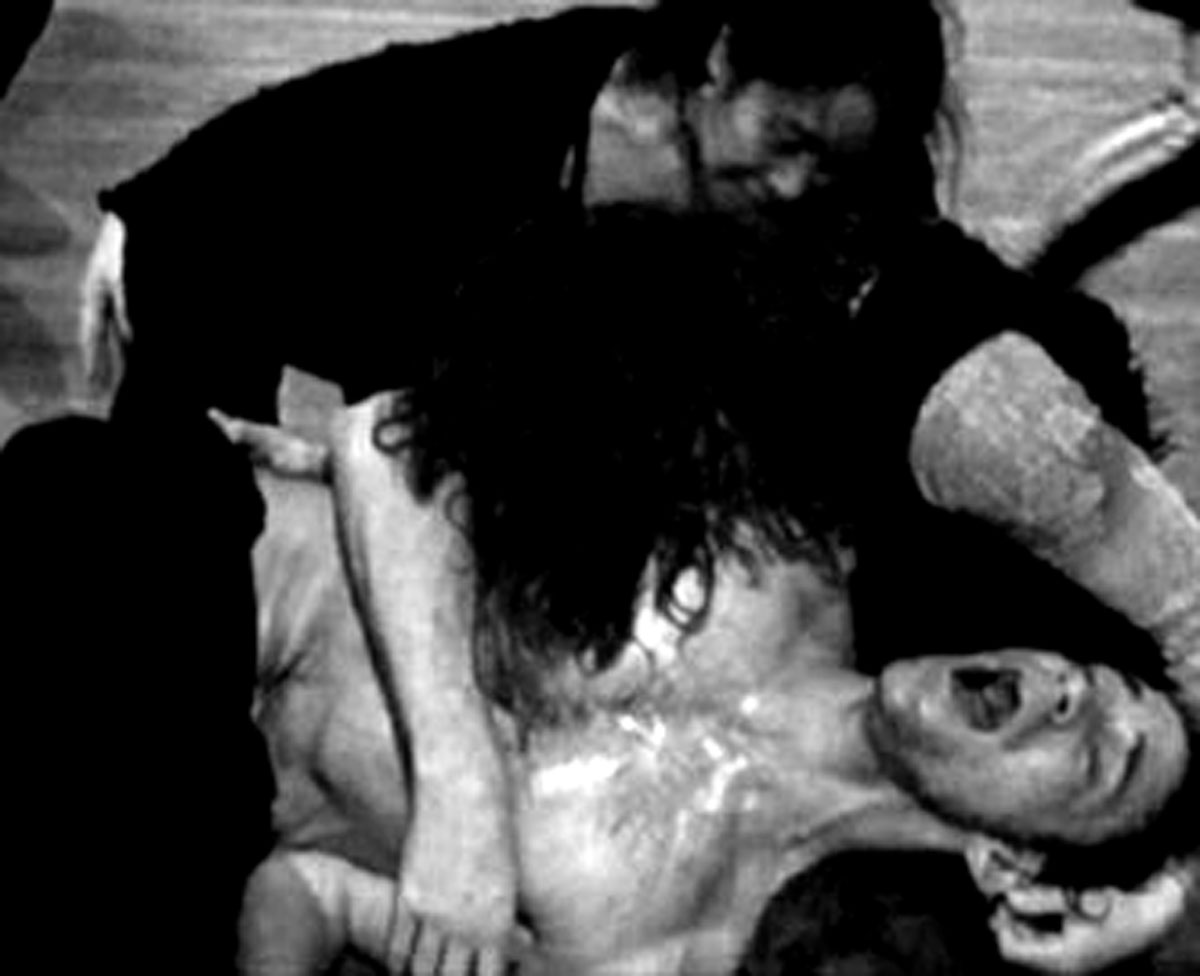
"Orphans of Delirium" - May. 2004 San Francisco CA
THE TOTAL ACT -- THE CAPACITY FOR RESONANCE
Why do we perform ? If we are to make real connection with the audience, our will to perform must first be liberated from all externally-driven considerations such as seeking acceptance, pleasing others, trying to impress the director, getting attention, love or approval, or seeking external acceptance for our talents, skills, and abilities. Only when the will to perform is emancipated from external social approval mechanisms can we become aligned with what Jerzy Grotowski has called "the total act".
Performance of the total act requires development of an internal faculty of resonance, i.e., the intuitive capacity for knowing truth. Resonance requires no understanding, forethought, or plan. We either resonate with a given direction or state or we do not. When we lose this resonating capacity, we suffer indecision and can be plagued by vagueness of direction. Whenever we can fully commit to the visceral and spiritual resonances within us, a ripple effect occurs. Like a stone dropped in a calm pool of water, our personal resonances indirectly stir similar resonances in others and in the audience. This mutual interaction of resonances relies on the performer's total commitment to their own visceral and spiritual sources which, in turn, trigger audience resonances. In this way, the audience experiences an amplification of their own presence and not just the impact of a performer's force, or will or charisma. After such a performance, the audience leaves exalted and amplified, as if they are leaving with more of themselves than when they arrived.
How can we cultivate a deeper capacity for resonance? A violin produces its resonate tones due to its empty chamber; stuff the violin with cotton and the violin becomes mute. To increase our internal resonating capacity, we must learn how to cultivate this kind of "empty chamber" within the instrument of the self. If we are stuffed with ideas, beliefs, techniques, and knowledge, our capacity for internal resonance quickly diminishes. The creation of internal space requires a process of "undoing" or emptying. There are many ways to initiate this process of undoing. The most direct and simple approach I have discovered, and use in paratheatre, is borrowed from Zazen meditation practice. In paratheatre, I refer to this method as "No-Form", a technique practiced in a standing posture, rather than traditional Zazen sitting mediation; one cannot move very far while sitting. The aim of this No-Form stance is to cultivate enough internal receptivity to detect and then, be acted on by autonomous forces in the body/psyche. By engaging and expressing these forces, we allow their presence to act through us as vessels in spontaneous movement, sound, gesture, and actions.
The W.N.S. (Wayne Newton Syndrome)
The audience/performer dynamic expresses an inherent imbalance. As performers, we're onstage because we exhibit, or should exhibit, more talent and skill than the audience that has paid to see us. The audience expects to be entertained and enlightened to some aspect of their lives and of their humanity. The audience arrives looking to be informed, stimulated, amused. Performers are paid to control the communication in whatever medium they're working in; performers call the shots, must call the shots. When the actors take charge and do their job, theatre happens. There is a difference, however, between theatre that just gets the job done and theatre that changes lives.
Performers of the theatre that changes lives must continually develop their craft in very specific and precise ways. Though these ways can differ in method for each performer, it starts with making choices on projects that stretch and expand our existing skill sets and talents. Without consistently challenging ourselves, performers can slip into plateaus of redundancy and stagnation by repeating what they already know and what they do best. Without consistent challenges, artists can easily sink into a quagmire of inertia; existing talents wither, corrupt or fritter away. We become more tourist than artist, more mimic than creator, more spectacle than substance. The Universal Patron Saint of Show Biz Glitz, Wayne "Mr. Las Vegas" Newton, demonstrates the fate awaiting those who only perform what they do best. Don't get me wrong. Mr. Newton is a wonderful and talented performer. He just does what he does over and over and over and over, again...and gets paid handsomely for it ...
“I’m still doing the kind of shows I’ve always done
and I can tell you one thing: people may leave one of my shows disliking Wayne
Newton, but they’ve never walked out saying, ‘He didn’t work hard for us’ or
‘He didn’t give us our money’s worth.’ " -- Wayne Newton
ON TALENT AND SKILL
Talent demonstrates a fluid capacity for access and expression of the internal landscape in a spirit of constant discovery. Skill refers to a dexterity for articulating the internal landscape through externally recognizable forms, symbols, images, and structures. Skill shows precision and clarity of form; talent shows “spirit” in action. Through talent we experience the presence, spontaneity and creative force of an artist; in skill, we experience virtuosity, technique, and sense of design and form. More often than not, artists and performers demonstrate an imbalance between talent and skill; too much spontaneity can overwhelm skill and too much structure can crimp talent.
Striking a dynamic balance between talent and skill is the aim of any committed artist and/or performer. The more exceptional the performer, the higher the integration of talent and skill. Though talent cannot really be taught, it can be nurtured by encouraging total freedom of self-expression. Skill, however, can be learned by consistent application of method and technique to clarify the form of whatever our talent can access and express. As talent and skill cohere at higher and higher levels, something miraculous occurs: high art.
Talent in paratheatre refers to an elastic capacity for accessing sources in the body itself, of mining the body for veins of autonomous forces, images, emotion, sensation, and the deeper complexes and numinous archetypes of the personal and collective Unconscious -- the inner actions of source-work or sourcing. Skill in paratheatre refers to the precision of expression and articulation of source-work. Paratheatre skills can be developed by an ongoing practice of the trigger methods innate to this medium.
THE UNDOING TECHNIQUE OF NO-FORM
The inner action of No-Form cannot be taught. Though No-Form represents a very direct and simple process, it can also be difficult and frustrating for anyone burdened by over-thinking, compulsive rationalization, and excessive self-analysis. The Inner Critic and the Ego Ideal naturally resists the prospect of being nothing. Other impediments to No-Form include: identification with self-images, preconceptions, ideals, beliefs, over-confidence and excessive certitudes. No-Form can be experienced as a kind of intimacy with Void, a comfort around being nothing... of being nobody.
No-Form can be approached in any standing posture of balance resulting in a position of vertical rest -- of standing with minimal effort -- and supporting a state of emptying or internal receptivity. The breath is focussed on the exhale, allowing the inhale to occur by reflex. Mentally, we relax the desire to control and the desire to control the outcome or any appearance of our expression. The intention here is to relax identifcation with any image or idea towards simply being nothing.
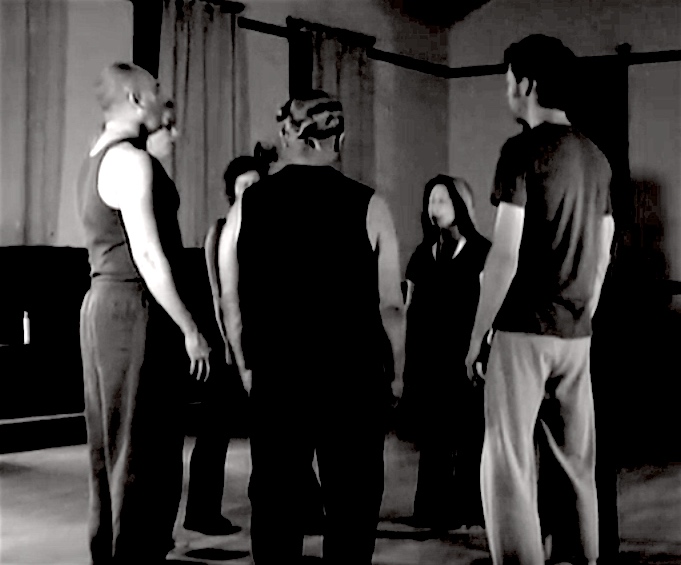
Dreambody/Earthbody Lab and Video, 2012 Berkeley CA
The On-Off Switch of No-Form
No-Form acts to charge a ritual to engage the body's vital forces and then, to discharge these forces after each ritual or performance. In this way, No-Form serves a double function as a receptivity point to creative energy and then, as a discharging point to release whatever enegries were engaged. It's like an on/off switch to our creative engines. Some performers seem to be "on" all the time, as if they never found the "off" switch. No-Form practice allows us to turn the creative engines on and off according to our needs. In this way, we are free to use our talents as tools. When we're done, we put the tool down. We no longer need to fear losing access to our creative sources or diminishing our talents when we know how to turn our creative engines on and off.
MANIFESTO LINKS
Part One: Orientation
culture, paratheatre,verticality, the asocial climate
Part Two: Integrity Loss and Recovery
sacrifice and increasing the force of commitment
Part Four: Self-Observation and Ego
function of ego, embracing contraries, emotional plague
Part Five: Self-initiation
on the bridge between the worlds and
what drains the power of dreaming